

SASKATOON, Saskatchewan, July 6, 2026 – Buffalo Potash Corporation (TSXV: BUFF) (OTCQB: BLPTF) (the “Company” or “Buffalo”) is pleased to announce its anticipated roadmap to production by way of its first facility, the Initial Production Module (“IPM“), at the Company’s flagship Disley property in Saskatchewan (the “Disley Project“), located adjacent to two of Canada’s currently producing potash solution mines (see Figure 1), the K+S Bethune Solution Potash Mine and the Mosaic Belle Plaine Solution Potash Mine.(1)
Disley Project Development Plan
The IPM is the first of three planned solution mining facilities at the Disley Project, with a design capacity of 125,000 tonnes per annum (“TPA”) of soluble-grade potash, with first production targeted in Q1 2027 and a lower initial CAPEX requirement compared to the full Disley Project build-out. At full build-out – comprising the IPM and two 500,000 TPA mines (“Disley East” and “Disley West“) – the Disley Project would be expected to produce up to 1,125,000 TPA of potash, as contemplated in Buffalo’s recently released preliminary economic assessment titled “NI 43-101 Preliminary Economic Assessment Technical Report on the Disley Potash Project, Saskatchewan, Canada” dated May 21, 2026, and effective April 15, 2026 (the “PEA”), a copy of which is available on the Company’s SEDAR+ profile at www.sedarplus.ca. On a standalone basis, the PEA attributes a payback period of approximately 12 months from the start of IPM production.(2) However, there is no guarantee that the Company will be able to achieve production.
The Company’s production decision for the IPM is not based on a feasibility study of mineral reserves demonstrating economic and technical viability, and such decisions are historically associated with a higher risk of economic and technical failure (see “Note 3 – Production Decision Cautionary Statement”).
Mr. Steve Halabura P.Geo., Chief Executive Officer of the Company, commented: “We just completed a very successful, upsized and oversubscribed non-brokered private placement that gives us significant balance sheet strength to advance the IPM – the foundation for our anticipated larger build-out to 1,125,000 TPA of potash production across the Disley Project. The IPM is intended to do three things for Buffalo: establish early commercial production; generate well data that will support a feasibility study for Disley East and Disley West; and demonstrate our patented Horizontal Line-Drive Mining Method at commercial scale. We anticipate the IPM will produce soluble grade potash that we intend to sell into local markets – including drilling fluid and proximal agricultural applications – which we anticipate will provide an early revenue foundation as we advance toward full commercial scale at Disley. With the drill rig mobilizing to site in July and first production targeted for Q1 2027, the months ahead will be the most active in the Company’s history.”
Mr. Quinton Hardage P.Eng. & PMP, President and Chief Operating Officer of the Company, commented: “We are happy to have reached this stage of development. The technical team is now assembled, and it is time to execute on our vision of creating a mining plane that is anticipated to allow Buffalo to only recover the high-grade minerals from the potash deposit, thus greatly simplifying the processing requirements on surface. Our technical team is made up of some of the best service providers in the industry that have unparalleled experience in potash drilling and horizontal well development. We look forward to embarking on the successful creation of a mining plane, something that we think could revolutionize how potash is solution mined in the future.”
IPM Development Plan
The IPM is designed for the Company to establish initial cash-flowing production at lower upfront capital cost, while building the operational and technical foundation for full-scale development. Development of the IPM is anticipated to be broken down into five phases, further detailed below.
- Source and disposal wells;
- Horizontal Line-Drive (“HLD“) drilling;
- Brine circulation;
- Site development; and
- Surface processing.
There is no guarantee that the IPM will be completed as presently expected or at all.
Source and Disposal – The first phase consists of drilling two vertical wells. The first well is anticipated to produce brackish water from the Mannville Formation (the “Source Well“), which is then anticipated to be saturated with NaCl for the solvent used in Buffalo’s solution mining method. The second well will be used to dispose of excess brine, in the Deadwood Formation, after it has been processed at surface (the “Disposal Well“). While both wells serve an ongoing operational role for the IPM, they will also be cored and logged through the potash-bearing members of the Prairie Evaporite Formation, further enhancing geological understanding of the site and providing data that will inform the feasibility study for the larger build-out of Disley East and Disley West, detailed further below.
HLD Drilling – Buffalo will then drill three horizontal wells from a single pad: a central well for brine injection (the “Injection Well”) and two parallel wells on either side for brine collection (the “Production Wells”), each with a horizontal leg of approximately 500 to 600 meters positioned at the base of an identified high-grade potash seam. Together, these wells form the initial underground infrastructure for the IPM and will be used to develop the solution mining plane. Multi-stage packers are set along each horizontal well, creating a series of isolated injection and collection points that allow the Company to evenly distribute brine and control pressure across the mining plane as brine from the Source Well is dispersed throughout the high-grade potash seam.
Brine Circulation – Brackish water sourced from the Mannville Formation is brought to surface through the Source Well before being saturated with NaCl and pumped down the Injection Well to the Production Wells, thus creating the mining plane. Once the mining plane has been established, the NaCl-saturated brine selectively dissolves only the potassium-bearing mineral sylvite – sodium is left behind in the mining plane while the brine is progressively enriched in potassium chloride (KCl). The resulting KCl-rich brine is recovered through the Production Wells and delivered to surface for processing.
Site Development – In parallel, Buffalo will complete surface development of the IPM site. The site will be winterized for year-round operation, with insulated buildings housing the injection pumps, crystallizers, and related processing equipment, protective enclosures over the wellheads, and a storage building for finished product.
Surface Processing – The final phase is the installation and commissioning of the IPM’s processing plant. KCl-rich brine recovered from the Production Wells will be processed through a two-stage cooling crystallization circuit, with the resulting KCl crystals then centrifuged, dried, and bagged for shipment. The plant is designed to produce up to 125,000 TPA of soluble-grade potash, in addition to local sales of KCl-rich brine. Buffalo is also evaluating a Vortex Crystallizer for the IPM, which offers the potential for reduced capital and operating costs and may be tested during operation of the IPM.
Feasibility Study
Concurrently with development of the IPM, Buffalo intends to advance a feasibility study for the full build-out of the Disley Project. Core, geophysical logs, and other data obtained from the Source Well and Disposal Well are anticipated to be used to enhance geological certainty and confidence in the mineral resource, while operation of the IPM is anticipated to demonstrate the Company’s HLD mining method at commercial scale. Together, these workstreams are expected to provide the technical foundation for a feasibility study covering Disley East and Disley West, positioning Buffalo to advance toward full-scale development of the Disley Project. However, there is no guarantee that a feasibility study will be advanced as presently expected or at all.
Disley Project – General Overview
The Disley Project is located approximately 50 kilometers northwest of Regina and covers 10,610 hectares (Crown and Freehold mineral rights). The property is situated immediately adjacent to the east of the K+S Bethune potash solution mine and north of the Mosaic Belle Plaine potash solution mine – both of which are among the largest producing potash solution mines in the world. In the opinion of management, the Disley Project is in one of the most favorable areas of Saskatchewan for potash solution mining (see Figure 1) as evidenced by the success of these neighboring projects.(1)
On May 22, 2026, Buffalo released the results of its maiden NI 43-101 Mineral Resource Estimate and PEA for the Disley Project, prepared by Micon International Co Limited. The PEA outlined a phased, modular development plan contemplating full-scale production of up to 1,125,000 TPA of potash across three solution mining facilities, with an estimated after-tax net present value (NPV) of US$1.1B at a discount rate of 8% and estimated internal rate of return (IRR) of 30%.(2) Readers are encouraged to refer to Buffalo’s April 27, 2026 and May 22, 2026 news releases and the NI 43-101 technical report filed on SEDAR+ for complete details of the PEA and Mineral Resource Estimate.
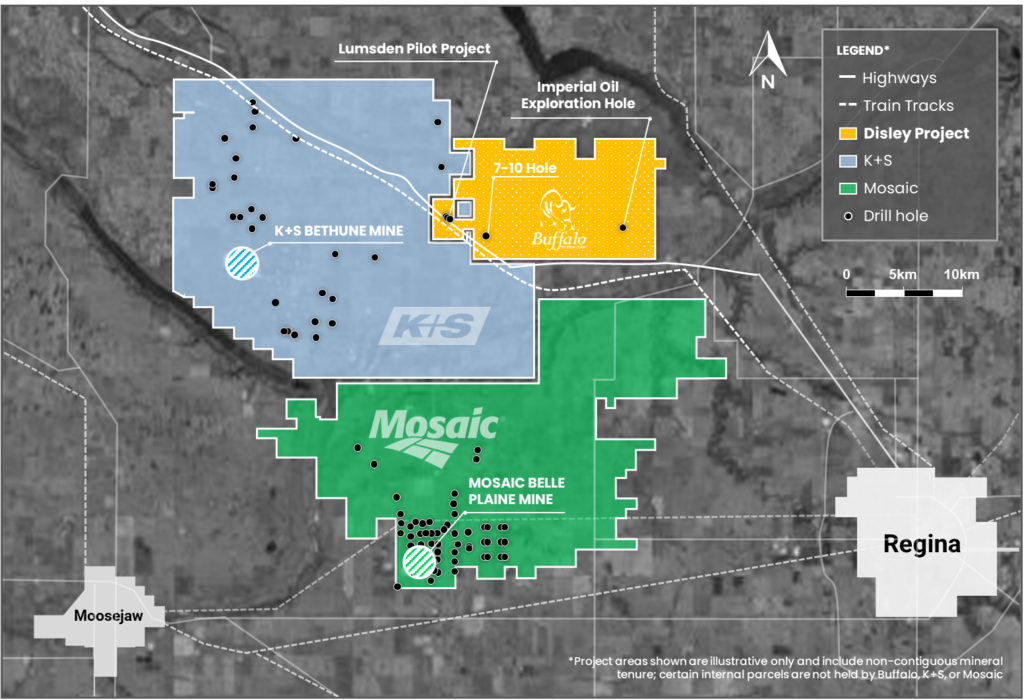
Figure 1: The Disley Property Situated Amongst Major Potash Solution Mines(1)
Engagement of Global One Media
The Company has also engaged Global One Media Group Pte. Ltd. (“Global One Media“), a global investor marketing and media firm, to support the Company’s digital investor communications strategy.
Under the engagement, Global One Media will assist the Company with the production of digital investor content, including video interviews and related corporate communications, and the distribution of such content through digital channels and media platforms, with the objective of increasing the Company’s visibility among investors across key global markets. The engagement is for an initial term of six months, with an effective date of July 1, 2026, continuing thereafter on a month-to-month basis unless terminated. In consideration for its services, the Company will pay Global One Media a monthly cash fee of US$7,500. No securities of the Company will be issued to Global One Media as compensation.
Global One Media and the Company are at arm’s length. Global One Media does not have any interest, directly or indirectly, in the Company or its securities, nor any right or intent to acquire such an interest. The engagement remains subject to acceptance by the TSX Venture Exchange.
About Buffalo Potash
Buffalo Potash is an emerging Saskatchewan-based potash developer pursuing a modular approach to selective solution mining through its patented Horizontal Line‑Drive (HLD) technology. Buffalo is advancing the Disley Project – located adjacent to two of the most prominent currently producing potash solution mines in the world – with the objective of establishing capital‑efficient, lower‑impact potash production in one of the world’s leading potash jurisdictions.
About Global One Media Group
Global One Media Group is a Singapore-based investor marketing and digital communications firm that helps publicly traded companies increase market visibility, strengthen investor engagement, and build sustained awareness across global capital markets. Through strategic positioning, premium content creation, and targeted digital distribution across its investor media network, Global One Media connects issuers with key investor audiences across North America, Europe, and Asia.
Qualified Person
The technical information in this news release has been reviewed and approved by Douglas F. Hambley, PhD, PE, P.Eng., PG, an independent consultant to the Company, who is a Qualified Person within the meaning of National Instrument 43-101 – Standards of Disclosure for Mineral Projects. This news release does not contain new technical disclosure beyond information previously disclosed in the NI 43-101 technical report for the Disley Project filed under the Company’s profile on SEDAR+ at www.sedarplus.ca. Readers are referred to that technical report, prepared by Micon International Co Limited, for complete details of the Mineral Resource Estimate and Preliminary Economic Assessment, including all data verification, methodology, assumptions, and qualifications.
All related and pertinent information has also been reviewed for this news release by Jared Galenzoski, P.Geo, FIMMM as an independent consultant to the Company who is a Qualified Person within the meaning of National Instrument 43-101 – Standards of Disclosure for Mineral Projects. Mr. Galenzoski is an expert in several potash-related fields including the drilling of potash horizontal wells and solution mining operations.
Contact
Steve Halabura | Chief Executive Officer & Director
Email: steve@buffalopotash.ca | Phone: 1-306-220-7715
Neither the TSX Venture Exchange nor its Regulation Services Provider (as that term is defined in the policies of the TSX Venture Exchange) accepts responsibility for the adequacy or accuracy of this release.
Notes
(1) The K+S Bethune potash solution mine and the Mosaic Belle Plaine potash solution mine (together, the “Adjacent Properties”) may each be considered an “adjacent property” (within the meaning of NI 43-101) to the Company’s Disley Project. The Company does not have any interest in either of the Adjacent Properties. The Company believes this context is useful in illustrating the proven endowment of the district, while noting that mineralization on adjacent or nearby properties is not indicative of mineralization on the Company’s Disley Project. There is no guarantee that the Disley Project will yield comparable results to either of these mines.
(2) The PEA was prepared by Micon International Co Limited in accordance with National Instrument 43-101 Standards of Disclosure for Mineral Projects and is preliminary in nature. The PEA includes inferred mineral resources, which are considered too speculative geologically to have the modifying factors and economic considerations applied to them that would enable them to be categorized as mineral reserves. Mineral resources that are not mineral reserves do not have demonstrated economic viability. There is no certainty that the results of the PEA will be realized. The after-tax NPV and IRR figures referenced above are based on the assumptions set out in the PEA technical report filed under the Company’s profile on SEDAR+ at www.sedarplus.ca, and readers are encouraged to read the technical report in its entirety, including all qualifications, assumptions, and exclusions that relate to the PEA.
(3) Production Decision Cautionary Statement: The Company’s decision to proceed with development of the IPM is not based on a feasibility study of mineral reserves demonstrating economic and technical viability. No mineral reserves have been established at the Disley Project, and the PEA is preliminary in nature (see Note 2). Historically, mineral projects advanced to production without first establishing mineral reserves supported by a feasibility study have a much higher risk of economic and technical failure. Specific risks associated with the Company’s production decision include, without limitation: that the grade, continuity, or thickness of mineralization differs from the Mineral Resource Estimate; that the Company’s Horizontal Line-Drive mining method, which has not been operated at commercial scale, does not perform as anticipated; that recoveries, production rates, or capital and operating costs differ materially from the PEA; and that the IPM does not achieve sustained or profitable production, which would materially and adversely affect the Company’s ability to generate revenue and cash flow.
Forward-Looking Information
This news release contains “forward-looking information” and “forward-looking statements” (collectively, “forward-looking information”) within the meaning of applicable Canadian securities legislation. Forward-looking information is generally identifiable by the use of words such as “believes,” “may,” “plans,” “will,” “anticipates,” “intends,” “could,” “estimates,” “expects,” “forecasts,” “projects,” or similar expressions, and the negative of such expressions.
Forward-looking information in this news release includes, but is not limited to, statements regarding: the timing, sequencing, and completion of the IPM development plan, including the drilling of the source, disposal, and horizontal wells, the development of the mining plane, site development, and the installation and commissioning of processing equipment; the completion of engineering design of the IPM; the anticipated timing of first production from the IPM; the anticipated timing and phasing of construction and commercial production for the IPM, Disley East, and Disley West; the preparation, timing, and expected benefits of a feasibility study for the Disley Project; the completion of detailed modeling, and the potential testing, of the Vortex Crystallizer; the engagement of Global One Media, the anticipated benefits thereof, and the receipt of TSX Venture Exchange acceptance therefor; the results, assumptions, and projections contained in or derived from the Mineral Resource Estimate and PEA for the Disley Project, including projected production rates and timing of production; expectations regarding the Disley Project’s potential for solution mining; the Company’s broader development plans and strategy for the Disley Project; and the fact that the Company’s production decision for the IPM is not based on a feasibility study of mineral reserves demonstrating economic and technical viability, and the associated increased risk of economic and technical failure.
Forward-looking information is based on management’s reasonable assumptions, estimates, analysis, and opinions made in light of its experience, perception of historical trends, current conditions, and expected future developments, as well as other factors that management believes are relevant and reasonable in the circumstances as of the date such statements are made. These assumptions include, but are not limited to, assumptions regarding geological continuity, potash grade and thickness, the applicability of historical data, the performance of solution mining methods, costs of production, the availability of services and equipment, the receipt of required permits and approvals, and the availability of financing on acceptable terms.
Forward-looking information is subject to known and unknown risks, uncertainties, and other factors that may cause actual results, performance, or achievements of the Company to differ materially from those expressed or implied by such forward-looking information. Such risks and uncertainties include, but are not limited to: the inherent uncertainty of PEA-level studies and the possibility that actual capital costs, operating costs, and production rates differ materially from estimates; risks related to exploration and development activities; uncertainty in geological interpretation; risks related to the development, commissioning, and operation of novel mining technology; risks inherent to solution mining operations and new or emerging technologies; regulatory approvals and permitting timelines; commodity price volatility; availability of capital; and general economic, market, and business conditions.
Although the Company has attempted to identify important factors that could cause actual results to differ materially from those contained in forward-looking information, there may be other factors that cause results not to be as anticipated, estimated, or intended. There can be no assurance that such information will prove to be accurate, as actual results and future events may differ materially from those anticipated in such forward-looking information. Accordingly, readers should not place undue reliance on forward-looking information. The forward-looking information contained herein is made as of the date of this news release, and the Company disclaims any obligation to update or revise such information, except as required by applicable securities laws.