
Buffalo Potash Corp.
The Disley Project
Located in the heart of Saskatchewan’s potash production region adjacent some of the most prolific potash solution mines globally.
Located in the World’s Best Jurisdiction for Potash Production
The Elk Point Basin of Saskatchewan is the world’s largest source of potash, spanning 1.2 million square kilometers, and by some assessments, may contain 40% to more than 50% of the world’s total potash resource. Since mining began in 1962, companies operating in the Elk Point Basin have produced more than 605 million tonnes of potash (KCl), underscoring the basin’s global and geopolitical importance to fertilizer supply and food security.
Source: Cocker, M.D., Orris, G.J., Dunlap, P., Yang, C., and Bliss, J.D., 2023, Geology and undiscovered resource assessment of the potash-bearing, Middle Devonian (Givetian), Prairie Evaporite, Elk Point Basin, Canada and United States: U.S. Geological Survey Scientific Investigations Report 2010–5090–CC, 145 p.
2026
Confirmation Phase
Buffalo is advancing a series of operational activities to assess the Disley Project. The Confirmation Phase is designed to inform a preliminary economic assessment of the long-term viability of a selective solution potash mining operation on the property using the Company’s patented Horizontal Line-Drive (“HLD”) mining system, subject to the results of ongoing technical work.
Key objectives for the Confirmation Phase:
- Drilling of Confirmation Well #1;
- Testing and analysis of historical core samples, including the historical pilot (see below);
- Completion of additional seismic interpretation;
- Evaluation of resource potential and preparation of a NI 43-101 technical report; and
- Commissioning and completion of a preliminary economic assessment (“PEA”).
The Disley Project is located in southern Saskatchewan, approximately 50km northwest of Regina and covers approximately 9,413 hectares.
The Disley Project is located approximately 50km northwest of Regina and covers 9,413 hectares. The property is situated immediately adjacent to the east of the K+S Bethune potash solution mine and north of the Mosaic Belle Plaine potash solution mine(2) – both of which are amongst the largest producing potash solution mines in the world. In the opinion of management, the Disley Project is in one of the most favorable areas of Saskatchewan for potash solution mining (see map below) as evidenced by the success of these neighboring projects(1)(2).
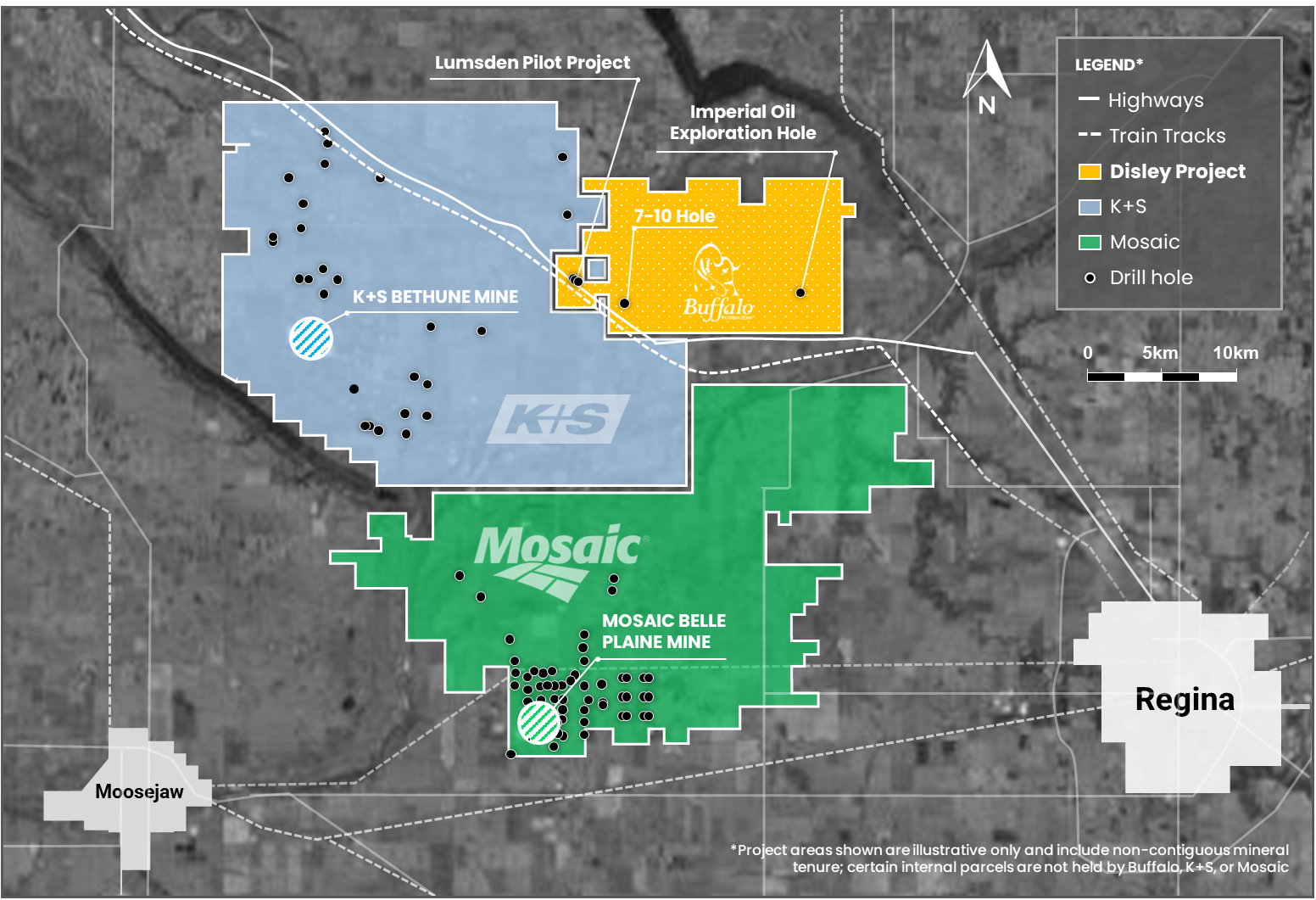
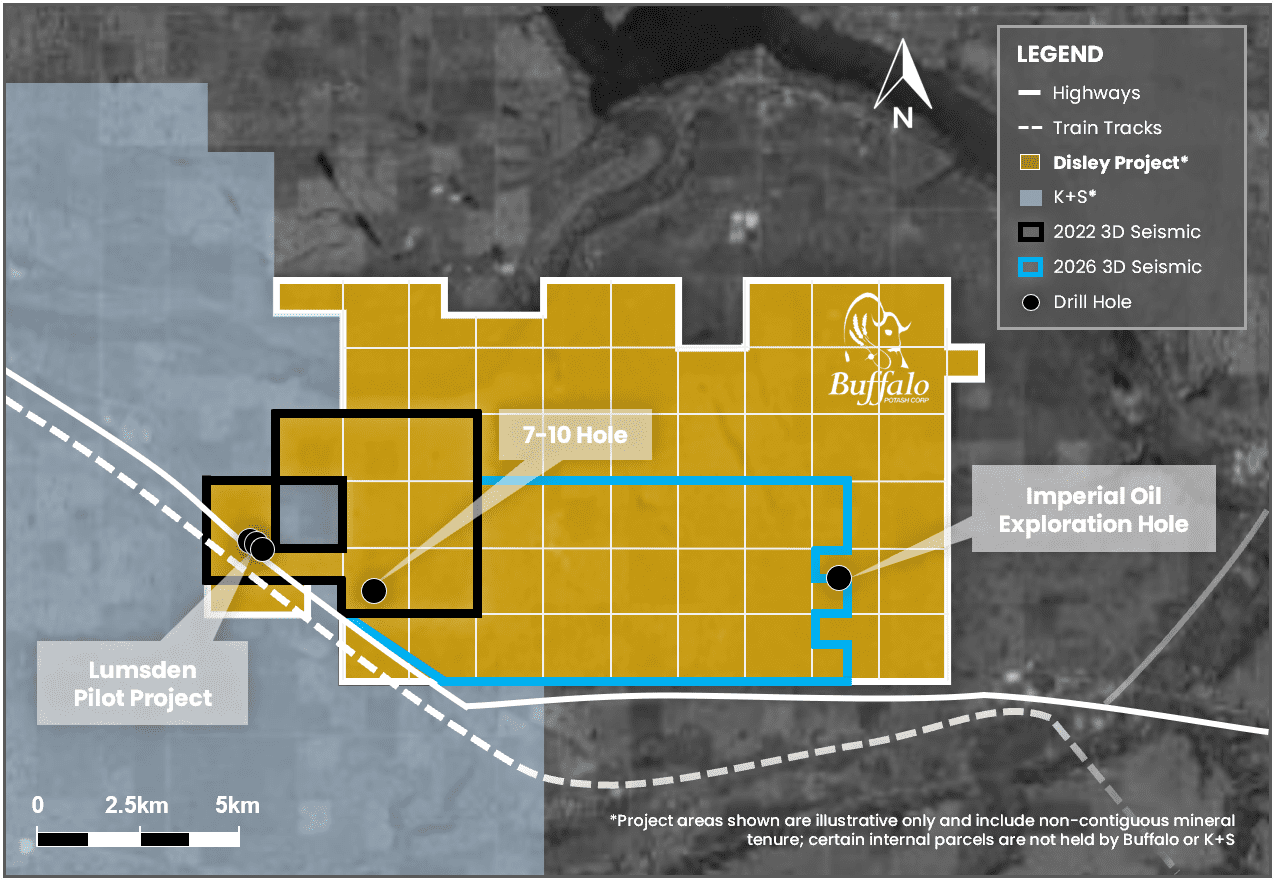
During the 1960s, two drilling programs were undertaken on the western and eastern portions of the Disley Project. Legacy potash core samples from these drilling campaigns (the “Legacy Drill Cores”) are now being re-assayed by Buffalo.
- (i) The Lumsden Pilot Project – On the west side of the property, the Lumsden Potash Development Company evaluated the potential for solution mining using brine injection and recovery wells.
- (ii) Imperial Oil Exploration Hole – On the east side of the property, Imperial Oil undertook potash-related exploration drilling as part of a regional potash exploration campaign.
The Company has initiated assay analysis on the Legacy Drill Cores from each of the Lumsden Pilot Project and the Imperial Oil Exploration Hole. Sampling and assay procedures are being undertaken by the Saskatchewan Research Council and will be consistent with the modern procedures being undertaken for Buffalo’s 7-10 Hole (as defined below). The assay results from these Legacy Drill Cores will contribute to an integrated geological and geophysical potash geoscience model (the “Potash Geoscience Model”) for the Disley Project and furthermore, will help the Company advance its understanding of the Disley Project with a view towards preparation of an updated NI 43-101-compliant Technical Report and PEA(1).
“Buffalo’s Disley Project is not only exceptional due to its location within Saskatchewan’s established potash solution mining district, in close proximity to some of the largest operating potash solution mines in the world(2), but also because of the historic technical work completed on the property to date.”
“Historic work completed by Imperial Oil(3) and the Lumsden Potash Development Company(4) on the Disley Project in the 1960s includes multiple potash exploration drill holes across the eastern and western portions of the Disley Project. These existing core samples provide valuable subsurface geological information – effectively extending our understanding of the project area without incurring the capital-intensive process of additional drilling. When integrated with a comprehensive 3D seismic program, and the drill core from our recently completed 7-10 confirmation hole, this dataset is expected to form a strong technical foundation to support the evaluation of the Disley Project with the goal of advancing toward an updated National Instrument 43-101 (“NI 43-101”)-compliant Technical Report and a PEA for the planned development of the showcase facility and initial mine(1).”
– Steve Halabura, P.Geo., CEO Buffalo Potash Corporation
Successful Completion of 7-10 Hole
On February 5, 2026, the Company announced the successful completion of its 7-10-20-23 W2M (the “7-10 Hole”) confirmation drill hole at the Disley Project, reaching a total depth of 1,563 metres. The hole successfully intersected all targeted potash-bearing members of the Prairie Evaporite Formation, with 108 metres of continuous core recovered at greater than 98% recovery. Core logging analysis, sampling, and assaying are underway, with results to be reported in due course.
3D Seismic Program
Buffalo is also initiating a ~45km2 3D seismic program on a portion of the Disley Project (the “3D Seismic Program”) designed to expand understanding of the geological continuity of potash beds on the property. The program will connect existing 3D seismic coverage completed by Buffalo in 2022 on the western portion of the Disley Project, including over the Lumsden Pilot Project (the “2022 3D Seismic”), to the Imperial Oil Lumsden Exploration Hole near the eastern boundary of the Disley Project (see Figure 2). Buffalo anticipates 3D seismic results will combine with the 2022 3D Seismic, potash assays from Legacy Drill Cores and the new 7-10 Hole drill core assay results to inform the Potash Geoscience Model.
Notes
(1) No mineral resources, as categorized by NI 43-101, have been defined on the Disley Project. The Company will need to conduct additional work in order to define mineral resources. There is no guarantee that the Company will be able to define mineral resources as categorized by NI 43-101 on its Disley Project.
(2) The K+S Bethune potash solution mine and north of the Mosaic Belle Plaine potash solution mine (together, the “Adjacent Properties”) may each be considered an “adjacent property” (within the meaning of NI 43-101) to the Company’s Disley Project. The Company does not have any interest in either of the Adjacent Properties. The Company believes this context is useful in illustrating the proven endowment of the district, while noting that mineralization on adjacent or nearby properties is not indicative of mineralization on the Company’s Disley Project. There is no guarantee that the Disley Project will yield comparable results to any of these mines.
(3) Klingspor, A.M. (1966). Cyclic Deposits of Potash in Saskatchewan. Bulletin of Canadian Petroleum Geology, Vol. 14, No. 2, pp. 193–207.
(4) Halabura, S.P. (Steve) and Hardy, M.P. (2007). An Overview of the Geology of Solution Mining of Potash in Saskatchewan. Technical paper presented at the Solution Mining Research Institute Fall 2007 Conference, October 8–9, 2007, Halifax, Nova Scotia, Canada.