Traditional underground tunnel mining of potash has significant CAPEX and infrastructural requirements. Drilling shafts and tunnels for underground mining is expensive and brings a lot of salt waste to the surface to be stored. Underground mines also require large production capacities to be able to amortize CAPEX. HLD preserves the integrity of local ecosystems by not storing salt waste on surface. This creates harmony with local communities and Indigenous Nations to create a long-term, sustainable economy for potash mining.
Solution mines do not require large-scale infrastructures, such as kilometre-long shafts and tunnels, and are, therefore, more economically viable. However, Solution Mining uses millions of cubic meters of fresh water each year to mine and produce potash. HLD Mining uses a negligible amounts of fresh water and primarily only for processing. HLD Mining is an eco-friendly technology that contributes minimal impact to the overall mining footprint.
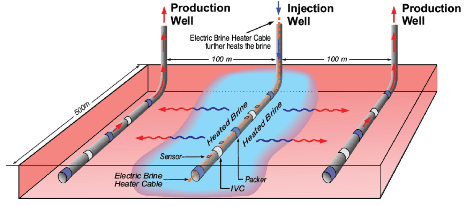
Horizontal Line Drive Selective Solution Mining was adapted from ‘tight oil’ horizontal drilling technology used in the Saskatchewan oil patch. The HLD Mining process drills wells parallel to high-grade potash seams in order to dissolve the potash. The potash brine is then pumped up to the surface, where it is crystallized. Our method maximizes access to surface areas in the richest, high-grade potash seam zones. Injecting mining fluid across multiple points along the horizontal wellbore leads to an even distribution of the fluid over the entire mining plane. This provides a sustainable way to reach inaccessible or distant pockets of potash.